The Staff Selection Commission (SSC) conducts several exams like CGL, CHSL, MTS, etc., across multiple shifts. To ensure fairness among candidates appearing in different shifts, SSC applies a normalisation procedure to adjust for any variation in exam difficulty. On June 2, 2025, SSC introduced a significant update, switching from the old normalisation formula to a new percentile-based method. This article explains the SSC normalisation formula old vs new, detailing the key changes, implications for aspirants, and how scores will now be calculated.
Old Normalisation Formula (Before June 2025)
Previously, SSC used a statistical formula to adjust raw scores and normalize performance across shifts. The formula took into account the average and top scores across all shifts, along with shift-specific values.
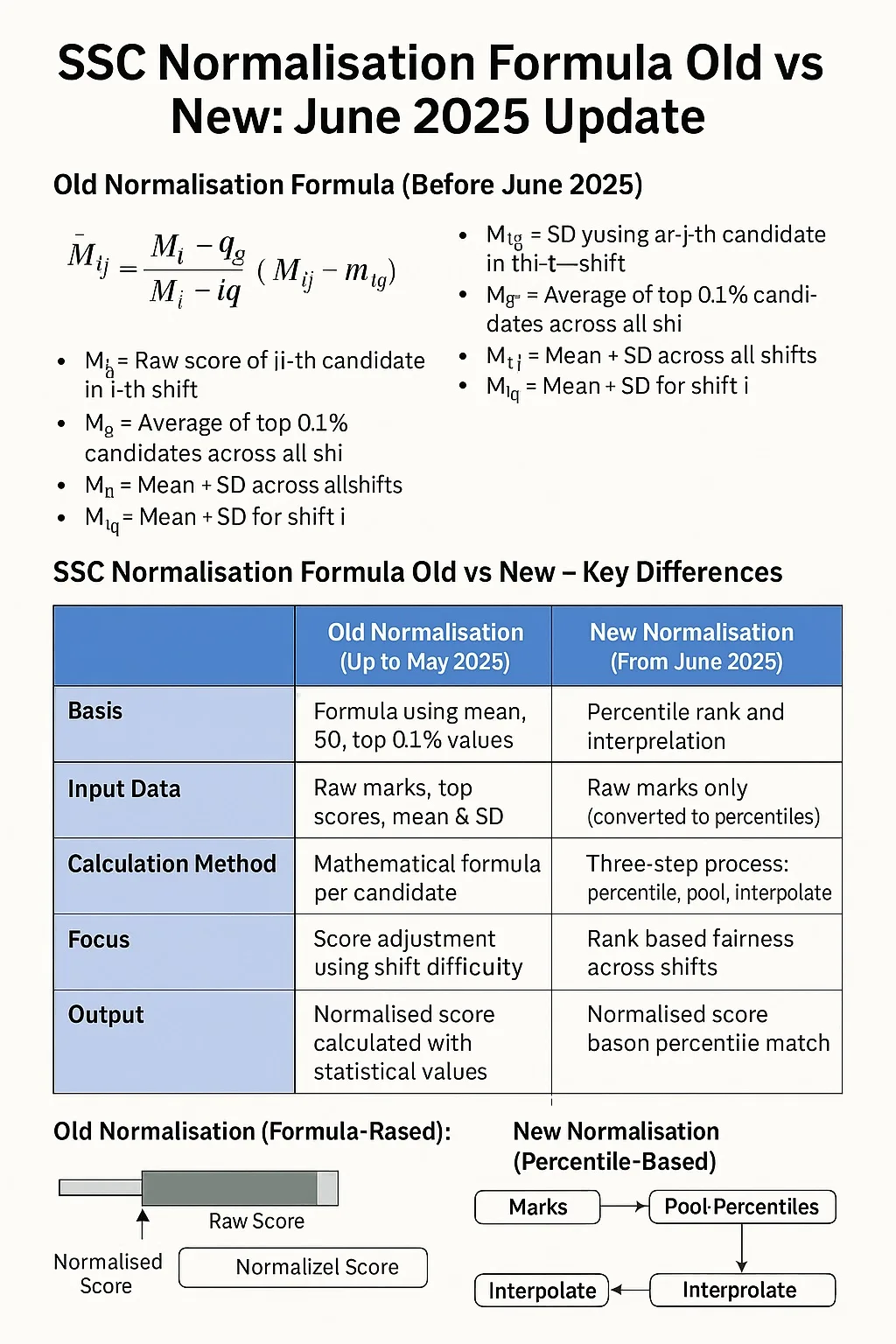
Old Normalisation Formula:
This method mathematically adjusted each candidate’s marks based on their shift’s difficulty. If a shift was tougher, scores were scaled upward, and vice versa.
New Percentile-Based Normalisation (From June 2025)
Starting from June 2025, SSC has replaced the formula-based system with a percentile normalization process. This method aligns candidate scores based on their relative performance within their shift and then across all shifts.
New Normalisation Process:
-
Convert Raw Scores to Percentiles
Each candidate’s raw score is converted to a percentile within their shift. -
Merge & Interpolate Percentiles Across Shifts
Percentile ranks from all shifts are pooled and sorted. SSC interpolates corresponding raw scores for each percentile. -
Map Percentile to Final Score
Each candidate is assigned a final normalized score based on their percentile rank in the combined distribution.
This system ensures a fairer and more transparent comparison of candidates across shifts by relying on their rank position rather than statistical parameters.
SSC Normalisation Formula Old vs New – Key Differences
The table below illustrates the differences between the old formula-based and the new percentile-based SSC normalization methods.
Table 1: Formula Comparison
| Aspect | Old Normalisation (Up to May 2025) | New Normalisation (From June 2025) |
|---|---|---|
| Basis | Formula using mean, SD, top 0.1% values | Percentile rank and interpolation |
| Input Data | Raw marks, top scores, mean & SD | Raw marks only (converted to percentiles) |
| Calculation Method | Mathematical formula per candidate | Three-step process: percentile, pool, interpolate |
| Focus | Score adjustment using shift difficulty | Rank-based fairness across shifts |
| Output | Normalised score calculated with statistical values | Normalised score based on percentile match |
Table 2: Procedural Flow
| Step | Old Method | New Method |
|---|---|---|
| Initial Calculation | Direct formula on raw marks | Convert raw marks to percentile |
| Cross-Shift Adjustment | Via statistical parameters | Percentile-based interpolation |
| Shift Difficulty Handling | Handled through SD and top scores | Handled through relative percentile rank |
| Transparency | Low (complex formula) | High (rank-based mapping) |
Visual Representation
Old Normalisation (Formula-Based):
Candidates’ scores were adjusted using formula-driven scaling with statistical inputs like standard deviation and top scores.
New Normalisation (Percentile-Based):
Marks → Percentile → Pool Percentiles → Interpolate → Normalised Marks
Why This Change Matters to Aspirants
The shift from the old formula to the new percentile-based system impacts how scores are processed but not how candidates should prepare. Here’s what aspirants should understand about the SSC normalisation formula old vs new:
-
Ranking over Statistics: The new system values relative performance (percentile) more than numerical score adjustments.
-
Transparency: Candidates can understand their normalized score better as it directly reflects their percentile.
-
Fairness: Both easy and tough shifts are treated equally by comparing percentile ranks, reducing chances of skewed scoring.
-
Simplified Outcome: Even though the new method has backend complexity (interpolation, pooling), the result is easier to interpret.
How to Strategize Under the New Normalisation
-
Focus on Consistency: Aim for a high percentile regardless of shift difficulty.
-
Avoid Guessing: Since your relative rank is key, wild guesses that bring down accuracy may hurt percentile rank.
-
Track Percentile Cutoffs: Begin monitoring not just raw score trends but percentile trends from mock tests and past papers.
-
Stay Updated: With this new method in play from June 2025 onwards, keep checking SSC notices for scorecards that reflect percentile mapping.
Conclusion
The transition in the SSC normalisation formula old vs new represents a structural upgrade towards a fairer and more understandable scoring process. The previous method relied on statistical calculations using means and top-scorer data, while the new percentile-based system maps each candidate’s performance in terms of relative standing. For SSC aspirants, the preparation approach remains the same, but the evaluation process is now more transparent and equitable. Understanding this update is crucial for those appearing in SSC exams from June 2025 onwards.

Raju G. | Founder & Editor at SarkariJobAlert
Hi, I’m Raju! I have been deeply involved in Indian career guidance and recruitment since 2012. With 12+ years of experience, my mission is to simplify the job-seeking process for every aspirant. Alongside my team, I work around the clock to bring you the most authentic and latest government job updates via our website and active social communities. My passion is seeing you succeed in your dream career.