Becoming an Intellectual Property (IP) lawyer is a specialized and rewarding legal path, especially in a technology and innovation hub like Hyderabad. With the rise of software development and the pharmaceutical industry, the demand for experts who can protect “creations of the mind” is at an all-time high.
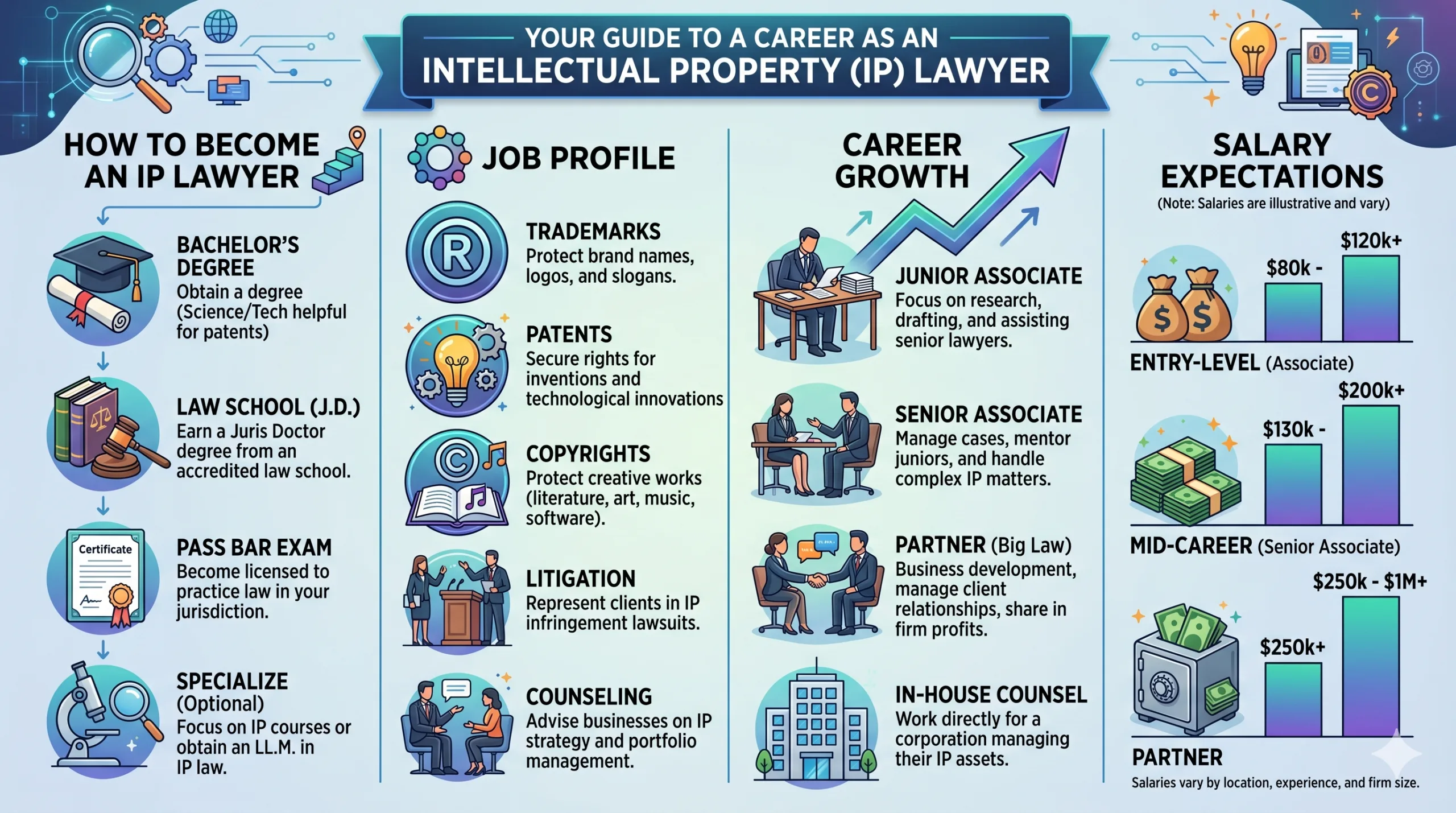
1. How to Become an IP Lawyer in India
To practice law in India, you must follow a structured educational and licensing path:
-
Educational Path:
-
5-Year Integrated LLB: After 12th grade, you can pursue a B.A. LLB, B.B.A. LLB, or even a B.Sc. LLB (highly recommended for patent law) from a National Law University (NLU) or a recognized university.
-
3-Year LLB: If you already have a degree, you can complete a 3-year LLB program.
-
-
Specialization: While an LLB is the base, IP law requires specific knowledge. Consider a Post-Graduate Diploma in Intellectual Property Rights (PGDIPR) or an LLM in IP Law.
-
Patent Agent Exam: If you have a background in science, engineering, or technology, clearing the Indian Patent Agent Examination is a massive advantage. It allows you to practice before the Patent Office even if you aren’t a litigating lawyer.
-
Bar Council Registration: After your LLB, you must register with a State Bar Council and clear the All India Bar Examination (AIBE) to practice in courts.
Upcoming Government Exams 2026: For 12th Pass & Graduates | Central & State-Level
2. Job Profile: What an IP Lawyer Does
The work is generally divided into two main categories:
-
Prosecution (Non-Litigation): This involves the “filing” side of law. You will help clients register trademarks, file patent applications, and manage copyright claims. This requires heavy research and drafting skills.
-
Litigation: Representing clients in court when their IP rights are infringed upon. For example, if a company uses a logo similar to your client’s or if a software code is stolen.
-
Transactional/Advisory: Drafting licensing agreements, franchising contracts, and conducting “due diligence” during company mergers to ensure all IP assets are valid.
3. Career Growth & Niche Opportunities
IP law offers a very clear and lucrative growth trajectory:
-
Junior Associate: Initial 1–3 years focusing on research and filing.
-
Senior Associate: Handling independent client portfolios and complex drafting.
-
Principal Associate/Counsel: Managing teams and leading high-stakes negotiations.
-
Partner: Owning a share of the firm or heading the IP department.
In cities like Hyderabad, there is a specific growing niche for IT & Software IP. Given the concentration of tech firms, lawyers who understand the intersection of web development, server optimization, and copyright law are in extremely high demand.
4. Salary Expectations
Salaries in IP law vary significantly based on the type of employer.
-
Boutique IP Firms: ₹5 – ₹9 Lakhs per annum (entry-level).
-
Tier-1 Corporate Law Firms: ₹12 – ₹18 Lakhs per annum (entry-level).
-
In-house Legal Teams (Tech/Pharma): ₹8 – ₹12 Lakhs per annum.