Preparing for the Civil Services Examination conducted by the Union Public Service Commission can feel overwhelming—especially if you’re starting from zero. The key is not intelligence alone, but clarity, consistency, and the right strategy. This 2026 roadmap gives you a practical, step-by-step plan to begin your journey toward services like the Indian Administrative Service, Indian Police Service, and Indian Revenue Service.
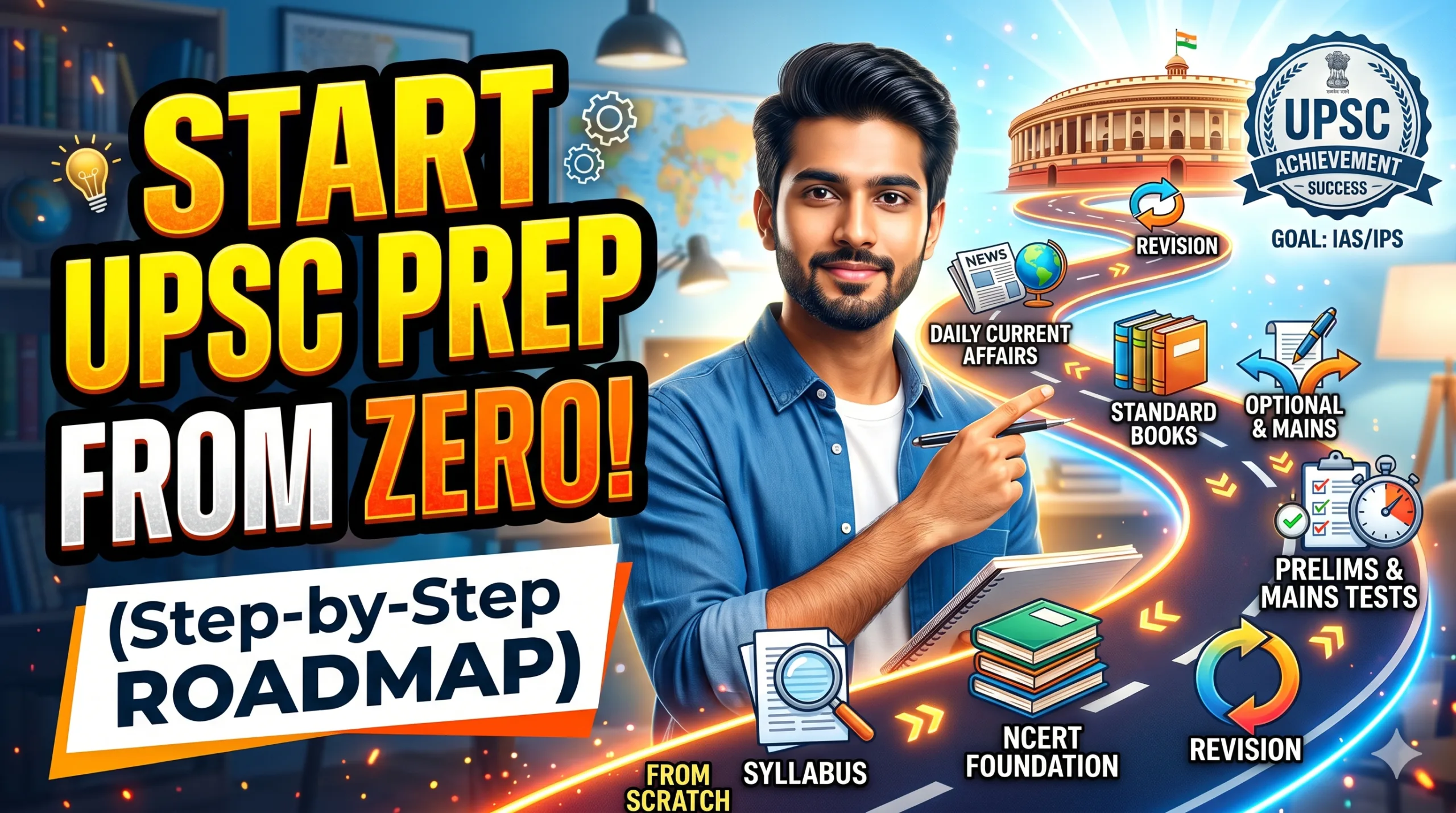
🎯 Step 1: Understand the UPSC Exam Structure
Before opening any book, know what you’re preparing for.
📌 Three Stages:
- Prelims (Objective) – Screening test
- Mains (Descriptive) – 9 papers (GS + Optional + Essay)
- Interview (Personality Test)
👉 Clearing all three stages requires different skills, so preparation must be integrated from day one.
📚 Step 2: Build a Strong Foundation (NCERT First)
Start with basic textbooks to build conceptual clarity.
Recommended:
- NCERTs (Class 6–12) for:
- History
- Geography
- Polity
- Economy
- Science
👉 These books form 70% of your base knowledge.
🗞️ Step 3: Start Reading Newspaper Daily
Current affairs are crucial.
Best sources:
- The Hindu
- The Indian Express
Focus on:
- Government policies
- International relations
- Economy
- Environment
👉 Avoid wasting time on politics gossip or irrelevant news.
📖 Step 4: Standard Books (Core Preparation)
After NCERTs, move to standard reference books.
Must-have books:
- Polity – M. Laxmikanth
- Modern History – Spectrum
- Economy – Basic + current affairs
- Environment – Shankar IAS
👉 Don’t collect too many books—limited sources, multiple revisions is the rule.
📝 Step 5: Start Answer Writing Early (Game Changer)
Most beginners delay this—big mistake.
Start after 2–3 months:
- Write 1–2 answers daily
- Focus on structure (Intro–Body–Conclusion)
- Practice previous year questions
👉 UPSC Mains is about presentation + clarity, not just knowledge.
🧠 Step 6: Choose Optional Subject Wisely
Optional subject can decide your rank.
Choose based on:
- Interest
- Background
- Availability of material
- Scoring trend
👉 Popular optionals include Geography, Public Administration, Sociology.
⏳ Step 7: Make a Realistic Study Plan
Daily routine (beginner):
- 6–8 hours study
- 2 subjects per day
- 1 hour current affairs
- Weekly revision
👉 Consistency beats long irregular study hours.
🔁 Step 8: Revision Strategy (Most Important)
Without revision, everything fades.
Rule:
- Revise weekly
- Revise monthly
- Make short notes
👉 “Study less, revise more” is the UPSC secret.
🧪 Step 9: Practice Mock Tests
For Prelims:
- Attempt sectional + full tests
- Analyze mistakes deeply
For Mains:
- Join test series (if possible)
- Improve answer structure and speed
👉 Practice converts knowledge into marks.
🧘 Step 10: Stay Consistent & Mentally Strong
UPSC preparation is a long journey (1–2+ years).
Challenges:
- Self-doubt
- Burnout
- Distractions
👉 Solution:
- Follow a routine
- Avoid comparison
- Take breaks when needed
📅 2026 Preparation Timeline (Suggested)
If targeting UPSC 2026:
2024–Mid 2025
👉 Foundation + NCERT + basic books
Mid 2025–Early 2026
👉 Advanced prep + answer writing + optional
Prelims 2026 (Mid Year)
👉 Full mock tests + revision
Mains 2026
👉 Intensive answer writing + current affairs
⚖️ Beginner Mistakes to Avoid
❌ Collecting too many books
❌ Ignoring revision
❌ Delaying answer writing
❌ Not analyzing mock tests
❌ Following random strategies
🏁 Final Thoughts
Starting UPSC preparation from scratch may look difficult, but thousands clear it every year with the same resources. What makes the difference is:
👉 Consistency + Smart Strategy + Patience
Remember, the goal is not just to pass an exam—but to prepare for a role with responsibility, impact, and service to the nation.
🔑 FAQs
Can a beginner crack UPSC in 1 year?
Yes, with full dedication and the right strategy, but consistency is crucial.
How many hours should I study daily?
6–8 hours consistently is enough for most aspirants.
Is coaching necessary for UPSC?
No, many toppers clear it through self-study with proper guidance.
When should I start answer writing?
Ideally within the first 2–3 months of preparation.
beginner-friendly UPSC booklist PDF you can follow directly.
daily timetable (hour-by-hour) for UPSC beginners
A rigid 12–14 hour timetable looks impressive on paper—but most beginners burn out within weeks. A realistic, repeatable 6–8 hour plan is what actually works for UPSC.
Here’s a practical hour-by-hour daily timetable you can follow from Day 1 while preparing for exams conducted by the Union Public Service Commission.
🕒 UPSC Daily Timetable (Beginner-Friendly – 6 to 8 Hours)
🌅 Morning Session (High Focus Time)
6:00 AM – Wake Up + Freshen Up
6:30 – 8:30 AM (2 hrs) → Core Subject 1
👉 Example: Polity / History
- Read + understand concepts
- Make short notes
☕ Break
8:30 – 9:00 AM → Breakfast + Rest
📰 Current Affairs Block
9:00 – 10:00 AM (1 hr) → Newspaper
👉 Read The Hindu or The Indian Express
- Focus on relevant topics
- Note important points
📘 Mid-Morning Session
10:15 – 12:15 PM (2 hrs) → Core Subject 2
👉 Example: Geography / Economy
- Continue NCERT or standard books
- Concept clarity is priority
🍽️ Lunch + Rest
12:15 – 1:30 PM → Break
✍️ Afternoon Light Session
1:30 – 2:30 PM (1 hr) → Revision
- Revise morning topics
- Update notes
🧠 Practice Session
2:30 – 3:30 PM (1 hr) → MCQs / PYQs
- Solve 25–50 questions
- Analyze mistakes (important!)
☕ Break / Nap
3:30 – 5:00 PM → Rest / Walk / Refresh
🌆 Evening Session
5:00 – 6:00 PM (1 hr) → Optional Subject / Light Topic
- Start optional slowly
- Or study Environment / Science
🌙 Night Wrap-Up
6:00 – 7:00 PM → Free Time / Family / Exercise
7:00 – 8:00 PM → Light Revision / Current Affairs Notes
10:00 PM → Sleep (Very Important)
⏱️ Total Effective Study Time
👉 6 to 8 hours (high-quality focus)
🔁 Weekly Adjustment Strategy
- 1 day/week → Full revision + mock test
- Reduce new study on that day
- Track weak areas
⚡ If You Are Working / Busy (4–5 Hours Plan)
- Morning: 2 hrs (core subject)
- Evening: 2 hrs (current affairs + MCQs)
- Night: 1 hr (revision)
👉 Consistency matters more than hours.
❌ Common Timetable Mistakes
- Studying 12+ hours (unsustainable)
- No revision time
- Ignoring MCQs
- Random subject switching
🧠 Pro Tips for Faster Progress
- Stick to 2 subjects per day
- Use Pomodoro (50 min study + 10 min break)
- Keep phone away during study
- Revise within 24 hours
🏁 Final Thought
This timetable is not about perfection—it’s about discipline you can repeat daily.
👉 Follow this for 3 months consistently, and you’ll build a solid UPSC foundation.
30-day beginner study plan
A 30-day plan won’t “complete UPSC”—but it builds the foundation and habits that make the next 6–12 months effective. The goal here is simple: NCERT base + current affairs habit + basic answer/MCQ practice.
Below is a day-by-day 30-day beginner study plan aligned with the exam by the Union Public Service Commission.
📅 30-Day UPSC Beginner Study Plan
🔰 Week 1 (Days 1–7): Foundation + Polity Start
🎯 Goal:
Understand basics + start Polity
Daily Structure:
- 2 hrs → NCERT (History/Geography)
- 2 hrs → Polity (Laxmikanth)
- 1 hr → Newspaper (The Hindu / The Indian Express)
- 1 hr → Revision
📌 Day-wise Focus:
- Day 1–2 → NCERT History (Class 6–7 basics)
- Day 3–4 → NCERT Geography (Class 6–7)
- Day 5–7 → Polity: Constitution basics, Preamble, Fundamental Rights
👉 Don’t rush—focus on understanding.
📘 Week 2 (Days 8–14): Polity + Geography Strengthening
🎯 Goal:
Build core subjects
Daily Plan:
- 2 hrs → Polity
- 2 hrs → Geography
- 1 hr → Current Affairs
- 1 hr → MCQs (start small)
📌 Topics:
- Polity → Parliament, President, PM
- Geography → Earth basics, climate, maps
👉 Start solving 10–20 MCQs daily
📗 Week 3 (Days 15–21): Economy + History
🎯 Goal:
Add new subject + improve understanding
Daily Plan:
- 2 hrs → Economy (basics)
- 2 hrs → Modern History (Spectrum)
- 1 hr → Newspaper
- 1 hr → Revision + MCQs
📌 Topics:
- Economy → GDP, inflation, banking basics
- History → Freedom struggle timeline
👉 Start linking current affairs with static subjects
📙 Week 4 (Days 22–30): Consolidation + Practice
🎯 Goal:
Revision + test mindset
Daily Plan:
- 2 hrs → Revision (all subjects)
- 2 hrs → Mixed subjects study
- 1 hr → Current Affairs
- 1 hr → MCQs (25–50 questions)
📌 Focus:
- Revise Polity + History thoroughly
- Attempt 1 mini mock every 2–3 days
- Analyze mistakes deeply
🔁 Weekly Targets Summary
| Week | Focus | Outcome |
|---|---|---|
| Week 1 | Basics + Polity | Strong foundation |
| Week 2 | Polity + Geography | Core subjects ready |
| Week 3 | Economy + History | Coverage expands |
| Week 4 | Revision + MCQs | Exam mindset |
📊 What You Achieve in 30 Days
✅ NCERT base started
✅ Polity basics covered
✅ Economy basics understood
✅ Daily newspaper habit formed
✅ MCQ practice initiated
❌ Beginner Mistakes to Avoid
- Trying to complete entire syllabus
- Ignoring revision
- Skipping current affairs
- Studying randomly without plan
🧠 Pro Tips
- Use same books repeatedly (don’t switch)
- Make short notes from Day 1
- Focus on understanding, not memorizing
- Track daily progress
🏁 Final Thought
These 30 days are about discipline, not perfection.
👉 If you complete even 80% of this plan properly, you’ll be ahead of most beginners.
Prelims 2026 Strategy Roadmap (Smart Plan to Clear in First Attempt)
Cracking Prelims conducted by the Union Public Service Commission is less about “studying everything” and more about mastering limited sources + revision + smart practice. This roadmap gives you a phase-wise, month-by-month plan to maximize your chances for Prelims 2026.
🎯 Understanding the Target
Prelims Papers:
- GS Paper 1 → Merit (cutoff decides selection)
- CSAT (Paper 2) → Qualifying (but risky if ignored)
👉 Goal:
- GS: 100+ safe score
- CSAT: Qualify comfortably (70–80 marks)
🗺️ Phase-Wise Roadmap (2025–2026)
🟢 Phase 1: Foundation Building (Now – Sep 2025)
🎯 Goal:
Strong basics + NCERT clarity
What to Study:
- NCERT (Class 6–12): History, Geography, Polity, Economy, Science
- Start Polity (Laxmikanth)
- Begin daily newspaper (The Hindu / The Indian Express)
Practice:
- 10–15 MCQs/day
- No pressure, focus on learning
👉 Outcome: Concept clarity
🔵 Phase 2: Core Preparation (Oct 2025 – Jan 2026)
🎯 Goal:
Complete standard books + start serious prep
Subjects + Sources:
- Polity → Laxmikanth
- History → Spectrum
- Geography → NCERT + GC Leong
- Economy → Basics + current affairs
- Environment → Shankar IAS
Practice:
- 25–30 MCQs daily
- Start sectional tests (weekly)
👉 Outcome: Syllabus coverage + familiarity
🟠 Phase 3: Intensive Practice (Feb – April 2026)
🎯 Goal:
Convert knowledge into marks
Focus:
- Full-length mock tests (1–2/week → later 3/week)
- Strong revision cycles
- Current affairs (last 1 year)
Strategy:
- Analyze every test deeply
- Identify weak areas
- Revise static + CA together
👉 Outcome: Accuracy + speed improvement
🔴 Phase 4: Final Revision (Last 45 Days)
🎯 Goal:
Maximum retention, minimum new study
Focus:
- Only revise notes + key books
- Daily MCQs (50+)
- 2–3 full mocks/week
Must Do:
- Revise Polity 3–4 times
- Revise Environment + Current Affairs multiple times
👉 Outcome: Peak performance
📊 Subject-Wise Strategy
🏛️ Polity (High Scoring)
- Revise Laxmikanth multiple times
- Focus on static concepts
🌍 Geography
- Maps + concepts
- Practice application-based questions
📜 History
- Modern history → priority
- Ancient/Medieval → selective
💰 Economy
- Concepts > theory
- Link with current affairs
🌱 Environment
- Current-based questions dominate
- Focus on reports, organizations
🔬 Science & Tech
- Basic + current developments
🧪 Mock Test Strategy (Game Changer)
Start Early:
- Phase 2 → weekly
- Phase 3 → 2–3/week
Golden Rule:
👉 Attempt → Analyze → Improve
Analysis Focus:
- Why wrong?
- Guessing accuracy
- Weak subjects
🎯 Attempt Strategy in Exam
- Target 75–85 questions attempt
- Accuracy > attempts
- Avoid blind guessing
👉 Smart elimination = higher score
⚠️ CSAT Strategy (Don’t Ignore)
Many fail here.
Practice:
- 2–3 days/week
- Focus on:
- Comprehension
- Basic maths
- Reasoning
👉 If weak → practice more early
❌ Common Mistakes to Avoid
- Reading too many books
- Ignoring revision
- Skipping mock analysis
- Over-relying on current affairs
- Ignoring CSAT
🧠 Golden Rules for Prelims
✔ Limited sources, multiple revisions
✔ Practice daily MCQs
✔ Focus on elimination techniques
✔ Revise current affairs at least 2–3 times
🏁 Final 7-Day Strategy
- No new topics
- Revise notes only
- Light MCQs
- Stay calm and confident
🔑 Final Thought
Prelims is not about being the smartest—it’s about being the most prepared and consistent.
👉 Follow this roadmap strictly, and you’ll be in a strong position to clear Prelims 2026.